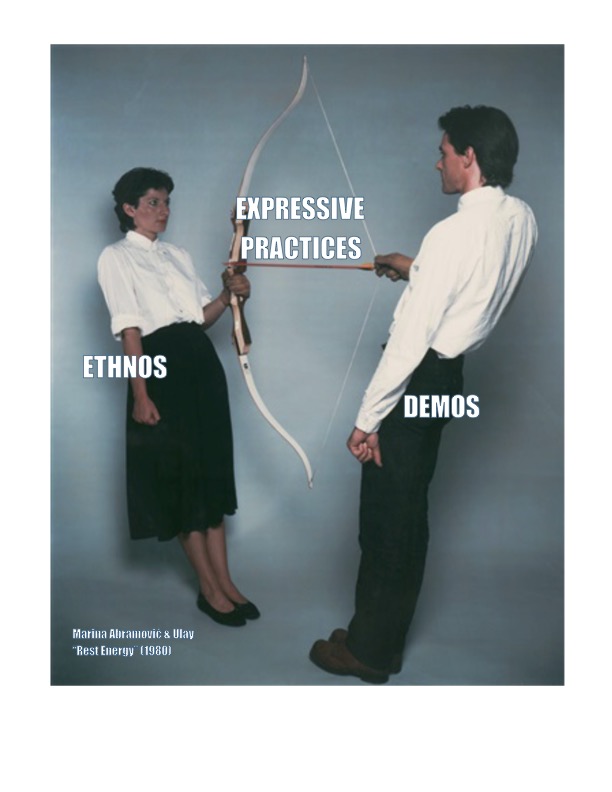
IASPM-US feels more and more like my home scholarly society these days and I was excited to present some in-progress research at this last February’s conference. In light of the cultural-political climate, meeting at the George Washington University Corcoran School of the Arts and Design in Washington, D.C. felt apropos. The folks there I count as friends and colleagues were characteristically brilliant and generous, and the research shared at the conference was inspiring. My own paper, “Modeling an Expansive Musical Body Politic,” reflected my ongoing concern with how ethno-national identities (characterized by a tension between “Ethnos” and “Demos”) are represented in ostensibly democratic nation-states characterized by radical plurality. I didn’t get to the bottom of things, per se, but I’m realizing in different ways how the tension inherent in-between constituent parts of complex identities are a feature of life. I close by quoting Susan Bickford (1996) from her The Dissonance of Democracy: Listening, Conflict, and Citizenship :
The world itself is what is in-between, what relates and separates us as subjects. Through speaking and listening to one another, we give that in-between particular meaning: we figure out how it relates and separates and how we might change and reconstitute the character of those relations and that distance. The goal here is not to erase the distance, but to be able to speak, listen, and act together across it. It is not our agreement that defines our intersubjectivity in this sense but our effort.
Regardless of its being very “in-progress,” I’m happy to share the paper and slides:
Modeling an Expansive Musical Body Politic
Intro
Musicologists take for granted that our musics socialize us; that the rules and norms that structure musical experiences index rules and norms that structure social experiences–implicit or explicit. Barry Shank (2014) reminds us how: “New possibilities for political community can emerge from the pleasurable experience of new formations of difference. This suggests that the emergence of political community is, in part, an aesthetic experience” (18). This emergence and mutual figuring are ongoing and contingent. Indeed, in the last fifty years of the advent of the New Musicology the WAM canon has been shown as a discursive space wherein “tonally moving forms” model categories of human identity, rules-based relationships, desire and transgression, and means of discipline and domination. Taken as a civic body, the organism of the orchestra, comprising agency-less workers under the discipline of a conductor, has been cast as a performance of ritual that produces and reproduces social norms in terms of class hierarchy as well as manifesting appropriate space for numinous wonder, power, and–perhaps–authority. So today I’m pursuing a few ideas broadly related to the orchestra and musical practices that imagine and perform American identity in contrasting ways: conversely valorizing difference and unity; mapping almost too facilely onto received ideas of harmony and dissonance a la “It’s a Small World Afterall.” However, I suggest it’s messier than that.
After some initial framing I’ll be discussing–all too briefly due to time constraints–the Chicago Immigrant Orchestra and Detroit’s Urban Arts Orchestra. I look to these for their exemplarity in illustrating modalities of difference that can be understood to condition the possibility of social structuring that necessarily exists in tension. Borrowing from sociological work of Emerich K. Francis (1965) I cast these modalities of difference as “ethnos,” represented by Detroit Urban Arts Orchestra, versus “demos,” represented by the Chicago Immigrant orchestra. In our present moment of rising ethnonationalism and isolationism I’m hoping to wring out of this brief discussion some insights about how musico-social structures have and continue to ask: “Who is appropriate to be a citizen? How might those citizens be voiced and heard as they demonstrate competing claims and needs in a social order that requires unity?
Ethnos & Demos
I’ve characteristically bitten off too much for this brief talk. The concept of “Democracy” is itself an ambiguous concept, but I’ll be thinking of it as the “people rule” described by the Ancient Greek “Demos/kratia.” This idea describes a kind of tension played out in the representation and shared choice making between members of a heterogeneous social group. Social agents in a Demos/kratia are working together in a relational, but overtly rules-based manner to mediate their differences. There’s more implicit plurality of worldview in a Demos. Conversely, the proximal idea of “Ethnos” implies a community bound by shared lifeworld. As the root of “Ethnography” and “Ethnomusicology,” Ethnos suggests a community characterized more by homogeneity of worldviews and lifeways. Again, this differs importantly from the “Demos” sort of community in that the Demos/kratia must work out how to understand and care for one another in their difference by crafting political instruments and processes to address issues of difference that, in a Ethnos, might be mediated by more relational practices and cultural expressions.
We’re here to talk about music so I’ll cut to that “thesis claim” part: I suggest that music – and culturally expressive practices broadly – comprises a crucial means by which we show ourselves to one another; how we experience and imagine what is and what could be – and one in which we can maintain a crucial and productive tension between the maintenance of the self among selves.
Internationalist and “American” Examples
Because music is play, it is pleasurable and fictive, there are literally an infinite number of examples and positions on this continuum between Ethnos and Demos. And they’re all useful in different situations for different outcomes., reflecting felt reality, modeling aspirational relations, entertaining, etc.
A familiar aspirational model of musical representation is a kind of internationalist aesthetic that flowered alongside the development of globalism in the 20th century. Music here was doing the aesthetic and political labor of performing unifying harmony between nation-states differentiated by ostensibly essentialized ethnonational differences. Johann Gottfried Herder would be proud. I’m thinking of films like Las Canciones Unidas (1960) which depicts international representatives at the United Nations Headquarters as they showcase musics representative of their respective cultures, seeking a “united song” that demonstrates their common values. Bela Fleck’s 2002 record Live at The Quick leans into a globalist performance of a different era of neoliberalism, helping us all hold hands through the cavalcade of polymorphous and complementary world musics. But let’s look to some older more nationalist attempts.
Large ensemble, symphonic attempts to construct a representative “American” art music that come immediately to mind include the Indianist composers of the early 20th century such as Edward MacDowell and Arthur Farwell who sought to voice a uniquely American concert music, gestures at accessible populism such as Copeland’s Appalachian Spring, or even Gunther Schuller’s third-stream music that imagined itself the cultivated apotheosis of jazz’s ostensive democratic nature. As most of us assembled here are invested in considering the “pop” in popular music, this resonates with the issue of just “who” or “what” is popular or even populist. An immediately relevant and proximate distraction is, of course, the upsets at official national centers for arts programming such as the Kennedy Center for the Performing Arts which has seen remarkable divestiture by artists and administrators since its renaming – and soon-to-be shuttering. A multitude of artists have cancelled – mostly those that can afford to. The Washington National Opera has left. And interesting to me and this study, the National Symphony Orchestra remains. For now. Presently under the baton of Gianandrea Noseda, the NSO performs the national anthem before every program. While still leading with a WAM sort of aesthetic framing that often valorizes and centers the canon, the National Symphony addresses American plurality through diverse programming and featuring contemporary works by composers such as artists-in-residence like Carlos Simon and has featured Dolly Parton and Ledisi in December 2024, Kendrick Lamar back in 2015. This month alone they’ve premiered American Promise, an NSO commission by Karen LeFrak, Peter Boyer and Joe Sohm’s musico-visual work American Mosaic, and for tonight they’ve programmed the Kennedy Center Citizen Artist Fellow Reena Esmail’s new double concerto.
Broadly speaking, one idea of “American” identity and excellence is represented through common practice period aesthetics at the National Orchestra. This balances that inherited 19th century German “cult of bildung” idea, its access to metaphysical dignity and truth via an ostensibly universal aesthetic and epistemic framing that venerates hierarchy, organicism, linear teleology, and the triumph of logos over muthos against musics that are intentionally representational of a plurality of other global identities, stories, aesthetics, and music making strategies.
However, this balance is being nudged by leaders that insist on putting their names on buildings and remaking the world as one that would benefit themselves and people that look and think like them. I’m talking about Trump and his supporters who would remove and deny history of the radical plurality of the United States while suppressing representation of minoritized populations for the overrepresentation of white male dominance; pushing a Christian ethnostate, forcing relations of Ethnos over Demos in a kind of re-ethnicization.
This is an old story. Even after the ostensive incredulity toward metanarrative that characterized the postmodern moment, “Capital C” Classical music remains charged in the cultural imaginary with those ideas of European high-class cultivation that justified hundreds of years of European imperialism and colonialism; ideas that valorized a cult of male genius while lamenting the necessity of the white man’s burden to civilize the world. In recent years the cat’s quite out of the bag regarding how musicological methods of analysis and evaluation have tacitly maintained these notions of WAM superiority, tautological and ideologically charged as they have been shown to be.
As I understand it, many rhyming modes of justification informed the logic of those who, two and a half centuries ago drafted ideas to found the United States of America, regarding who was appropriate to be a citizen, who should enjoy the rights of citizenship, whose concerns should be represented, who should have the franchise. It was divined by those framers, the scions of the Enlightenment, that it was men like themselves who were most appropriate to be citizens of a liberal democracy: educated white men of property. Only through violence has this shifted in the intervening centuries to secure the status of “human” and the rights of personhood and representation for all regardless of gender, class, ostensive race, etc.
“Primordial Attachments” vs “Civic Order”
In his own study of then-new African states in the 1960s Clifford Geertz (1963) noted a challenge unique to new states attempting to create mechanisms of civic representation for heterogeneous citizens, representing and offering equal possibilities of a good life for social subjects in full recognition of their multiethnic, multilinguistic, multiracial plurality. He characterized tensions between what he called “primordial attachments,” those thick and commingled elements of one’s identity like language, customs, and religious belief against the demands of civil order. He says:
To subordinate these specific and familiar identifications in favor of a generalized commitment to an overarching and somewhat alien civil order is to risk a loss of definition as an autonomous person, either through absorption into a culturally undifferentiated mass or, what is even worse, through domination by some other rival ethnic, racial, or linguistic community that is able to imbue that order with the temper of its own personality…The insistence on recognition as someone who is visible and matters and the will to be modern and dynamic thus tend to diverge, and much of the political process in the new state pivots around an heroic effort to keep them aligned. (109)
Though Geertz is speaking here of states in Africa responding to the exigencies of postcolonialism many of these ideas still resonate for the project of United States as it struggles–now 250 years in–to manifest an American ethnonationality that bespeaks a unified civic identity while, ideally, recognizing the more “primordial” ethnic and cultural plurality of those citizens that comprise it. In ways the framers of the US system of representation perhaps didn’t expect, capital problematizes the potentially productive antagonism between primordial sentiments and civility.
The Problem(s) of Capital
A multicultural and internationalism aesthetic that venerates global plurality is familiar to anyone that grew up in the 1980s and 90s. This reflected the growing global dominance of neoliberal capitalism that has “united” citizen consumers beyond national borders. Wendy Brown (2015) reminds us that in this capacity, we are all connected by the conditioning of all human phenomena as economic. She notes:
All conduct is economic conduct; all spheres of existence are framed and measured by economic terms and metrics, even when those spheres are not directly monetized. In neoliberal reason and in domains governed by it, we are only and everywhere homo oeconomicus, which itself has a historically specific form. Far from Adam Smith’s creature propelled by the natural urge to “truck, barter, and exchange,” today’s homo oeconomicus is an intensely constructed and governed bit of human capital tasked with improving and leveraging its competitive positioning and with enhancing its (monetary and nonmonetary) portfolio value across all of its endeavors and venues. These are also the mandates, and hence the orientations, contouring the projects of neoliberalized states, large corporations, small businesses, nonprofits, schools, consultancies, museums, countries, scholars, performers, public agencies, students, websites, athletes, sports teams, graduate programs, health providers, banks, and global legal and financial institutions. (10)
Globally dominant investment in the neoliberal logic of capital acquisition and economic growth above all means that “democratic state commitments to equality, liberty, inclusion, and constitutionalism are now subordinate to the project of economic growth, competitive positioning, and capital enhancement” (26). Brown wrote this in 2015 during the second Obama administration, not yet responding to the Trump administration’s bald and violent saying of the quiet part loud. It is clear that present Executive leadership would ignore reality to figure American music as that which reflects the dominance of an imagined patriarchal, white, and Christian American ethnostate. And it would orient that ethnostate toward violent extraction and acquisition for an elite class.
As my title implies, I’m interested to better understand how the musics, might model an expansive musical body politic reflective of an egalitarian social structure that honors that tensions outlined by Geertz between primordial and civic sentiments. And for this project I’ve been considering musical ensembles that intentionally participate in “orchestral” traditions contending to represent or model their respective communities, leveraging what sound can do.
I’m attracted to the idea of the capacity of music to represent individuals–and to function as resistance–that Brandon LaBelle calls “sonic agency.” This functions as:
a means for enabling new conceptualizations of the public sphere and expressions of emancipatory practices – to consider how particular subjects and bodies, individuals and collectives creatively negotiate systems of domination, gaining momentum and guidance through listening and being heard, sounding and unsounding particular acoustics of assembly and resistance. (4)
Taking sonic agency seriously frames our capacities for sounding and being heard for their relational force, potentially enabling new formations of social solidarity, especially as weapons against a neoliberal logic of privatization. It may sound facile or naive to suggest that our capacity to listen is what makes politics possible, but such is the suggestion of Susan Bickford in her study, The Dissonance of Democracy: Listening, Conflict, and Citizenship (1996). Our capacities to both speak and listen in a democratically conditioned social space is a source of conflict, but also the opportunity to devise means of relation. Whatever comprises “politics” is hard in terms of defining activities and strategies of living together. But beyond that, so too is the articulation of our capacities for reflection and consideration that ground the possibility of that ethical relation. Bickford suggests that politics is not “shared interests or shared conceptions of the good; it is how we decide what to do in the face of conflict about all these things. Politics in this sense is constituted neither by consensus nor community, but by the practices through which citizens argue about interests and ends–in other words, by communication” (11). Understood this way, citizenship is not just a legal status but a practice that involves communicative engagement with others in the political realm. Politically musical activities may be understood as those that enact and demonstrate for citizens the “ties between their own self-interest and the good of the political community, and of how these ties affect what public decisions should be made” (12).
OK, finally to orchestral examples.
Urban Art Orchestra
Manifesting an Ethnos orientation, the website of Detroit’s Urban Art Orchestra describes it as “a 20+ member group that celebrates music from the colorful mind of world-renowned composer De’Sean Jones, a Billboard-charting recording artist and award-winning arranger.” Featuring strings, harp, horns, a full rhythm section, percussion, vocals, DJs, and Jones on tenor saxophone, the Urban Art Orchestra performs music that indexes the cultural and historical logic of the majority-Black city.
Recognized for its excellence and service by the Detroit City Council with a “Spirit of Detroit Award,” the orchestra can be heard at the Detroit Symphony Orchestra’s Fisher Music Center, at Detroit’s famous jazz club Cliff Bell’s, or the Aretha Franklin Amphitheater. Performing original music and arrangements by De’Sean Jones, one is likely to chamber music inspired by hip-hop and electro-acoustic music as much as the musics of Wayne Shorter or the Coltranes. Original compositions often venerate the legacies of local heroes such keyboardist Amp Fiddler, jazz promoter Bill Foster, or featuring standout soloists such as violinist Mahki Murray. This is local music that knows where it’s from and reflects the shared values. For Detroiters, the Urban Arts Orchestra models an “ethnos” orientation that reflects local tastes, values, and histories, synthesizing WAM performance practices with local musical life.
The Chicago Immigrant Orchestra
To me, this ensemble rings of a late 20th century American liberal ideal of diverse citizenship: one wherein difference and its harmonization with its respective “others” might be performed explicitly. Rather than consign each performer to a role as an anonymous and interchangeable performer, this kind of conspicuous difference stands on the identity of each individual’s difference; how their particular instrument may be novel in an orchestra setting, how their musical aesthetics (and, ostensibly other characteristics might be smoothed over); how “we’re not so different, you and I.”
Running initially from 1999-2004, the present iteration of the Chicago Immigrant Orchestra began in 2019 when the Chicago Department of Cultural Affairs and Special Events asked guitarist Fareed Haque and oud player Wanees Zarour to revive the orchestra for the 2020 Chicago World Music Festival. It presently comprises a 20-piece ensemble “drawn from Chicago’s immigrant communities, representing an eclectic mix of musical heritages from across the globe. Under the artistic direction of Haque and Zarour, musicians hailing from the Far East to Western Europe, Africa, and the Americas collaboratively shape the orchestra’s musical narrative.”
“Embracing a fresh perspective,” their website tells us, “the New Chicago Immigrant Orchestra delves into the interplay between diverse musical traditions, weaving a rich tapestry that celebrates both their shared connections and distinctive differences.” Co-directors Haque and Zarour can be heard describing the harmony of the musicians–who play musics the directors and they themselves compose–model potential social harmonies aesthetically. They’re not too cute about it, I don’t think. I mean, they’re not naive people. They recognize that their musical harmony is a kind of labor. For a listener, music here functions as a heuristic space to play with difference, try on unfamiliar aesthetics…and potentially identities. Moreover, potential unfamiliar-but-palatable musics might encourage a listener to make the leap into a resonance not only with the music of another, but a recognition of their humanity. “Perhaps we’re not so different, you and I.’ This is, of course, a familiar dream of globalism, from United Colors of Benetton ads to cruise ship buffets: have a taste of the world!
Rather than a shared “ethnos” orientation, the Chicago Immigrant Orchestra models a “demos” model of difference, with mutually-agreed upon shared rules and practices that occasion a kind of musical Agora for citizen musicians to show themselves to one another in their difference; to hear the world from a different perspective.
Conclusion
My takeaway from this research supports my intuition: in our hyperglobalized and interconnected world, over-representations of static identity may occasion problematic outcomes. This is doubly the case in a public sphere characterized by radical plurality such as the United States. Neither that kind of musical body politic modeled by the Chicago Immigrant Orchestra or the Detroit Urban Art Orchstra is sufficient laone. Rather, we must be capacious in our social musicking that valorizes a kind of in-between difference and unity; respecting traces of primordial sentiments that then comprise civil sentiments. Susan Bickford says it this way:
The world itself is what is in-between, what relates and separates us as subjects. Through speaking and listening to one another, we give that in-between particular meaning: we figure out how it relates and separates and how we might change and reconstitute the character of those relations and that distance. The goal here is not to erase the distance, but to be able to speak, listen, and act together across it. It is not our agreement that defines our intersubjectivity in this sense but our effort. (171)
Therefore, it is we, together, who “reconstitute this in-between world through the joint attempts to make sense, by creating auditory paths that allow the possibility of meaningful action together.” It is this capacity to listen to one another in our sonic agency that might make it possible to live in accordance with democratic ideals. Mutually-constructive as our musical and social structures are, “[i]f we are ever to move from our inegalitarian social order to a diverse, egalitarian, and democratic one, we must speak and listen in a way that sustains and extends the possibility of actively making sense together” (173).
References
Bickford, Susan. 1996. The Dissonance of Democracy: Listening, Conflict, and Citizenship. Cornell University Press.
Brown, Wendy. 2015. Undoing the Demos: Neoliberalism’s Stealth Revolution. Zone Books.
Chicago Immigrant Orchestra. 2026. “Our Mission.” https://immigrantorchestra.org/our-mission.
Francis, Emerich K. 1965. Ethnos und Demos: Soziologische Beiträge zur Volkstheorie. Berlin: Duncker und Humblot.
Geertz, Clifford. 1963. “The Integrative Revolution: Primordial Sentiments and Civil Politics in the New States,” in Old Societies and New States, edited by Clifford Geertz. The Free Press of Glencoe.
LaBelle, Brandon. 2018. Sonic Agency: Sound and Emergent Forms of Resistance. Goldsmiths Press.
Joppke, Christian. 2003. “Citizenship between De- and Re-Ethnicization.” European Journal of Sociology/Archives Européennes de Sociologie 44 (3): 429–58.
Shank, Barry. 2014. The Political Force of Musical Beauty. Duke University Press.
The Beautiful Machine Magazine. 2025. “De’ Sean Jones Big Performance at Cliff Bells (sic) – Urban Art Orchestra,” 05/16/2025. https://www.thebeautifulmachinemag.com/blog/post/de-sean-jones-big-performance-at-cliff-bells–urban-art-orchestra
 AJ Kluth